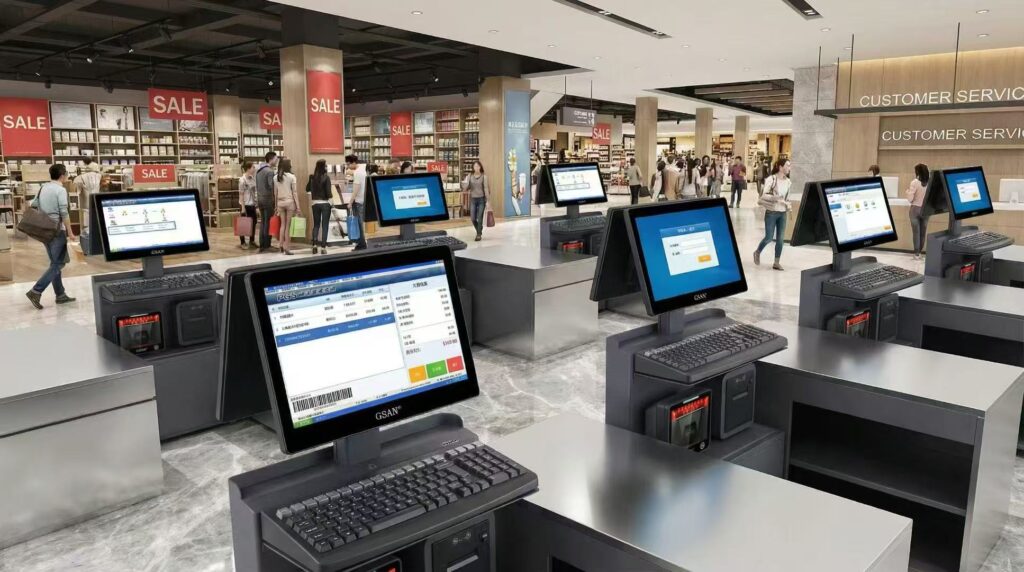
Introduction: What Is a POS System and Why It Is Essential for Modern Businesses
Retail and service industries worldwide rely on Point of Sale (POS) systems every day to process transactions and manage operations. According to Grand View Research, the global POS market is expected to reach USD 181.4 billion by 2030, reflecting how rapidly businesses are upgrading from traditional registers to modern, intelligent POS solutions.
But what exactly is a POS system, and why does it matter so much?
What Is a POS System?
A POS system is the place where a transaction takes place — combining hardware and software to record sales, accept payments, and manage business data.
The two primary components include:
-
Hardware: touch screen POS terminal, receipt printer, barcode scanner, cash drawer, customer display
-
Software: sales processing, tax calculation, inventory tracking, reporting
Research by the National Retail Federation (NRF) highlights that modern POS systems have evolved from simple cash registers into comprehensive business management tools used by retailers, restaurants, hotels, and service providers.
Why Your Business Needs a POS System
Industry experts and POS analysts have identified six major reasons why POS systems are indispensable in today’s business environment.
1. Increased Operational Efficiency
According to Investopedia’s analysis of retail operations, even a basic POS setup significantly improves transaction speed and reduces human error.
A responsive touch screen terminal combined with reliable peripherals ensures:
-
Faster checkout
-
Accurate pricing
-
Fewer manual steps
-
Smoother daily operation
This is why many retail and F&B chains worldwide standardize on commercial-grade POS terminals rather than consumer tablets.
2. Selling Across Multiple Locations
Data from Statista shows that mobile and cloud-based POS adoption continues to grow, enabling businesses to extend operations beyond a fixed store.
A mobile POS makes it easy to sell at:
-
Outdoor events
-
Pop-up stores
-
Food trucks
-
Markets and fairs
Compact, battery-powered POS hardware makes multi-location selling seamless and synchronized.
3. Real-Time Sales Analytics
Modern POS platforms provide real-time dashboards that help businesses understand performance instantly.
A report from McKinsey indicates that businesses using real-time sales analytics can improve operational decisions by up to 30%.
A stable POS terminal ensures accurate on-site data, including:
-
Hourly sales
-
Best-selling items
-
Payment methods
-
Revenue trends
4. More Accurate Inventory Management
The Harvard Business Review notes that poor inventory visibility can reduce profitability by more than 10%.
When integrated with 1D/2D barcode scanners and product databases, POS systems help:
-
Track stock automatically
-
Reduce counting errors
-
Improve replenishment speed
-
Prevent out-of-stock issues
For businesses with hundreds of SKUs, POS-driven inventory control becomes essential.
5. Better Employee Insights
POS systems allow businesses to track employee performance — a feature highlighted by many leading POS software providers such as Square and Lightspeed.
With employee accounts and shift tracking, businesses can monitor:
-
Sales volume per staff
-
Transaction accuracy
-
Refund patterns
-
Productivity
This data supports training, performance reviews, and operational optimization.
6. Simplified and Accurate Tax Management
Tax compliance is a major challenge for small and medium businesses.
The U.S. Small Business Administration (SBA) recommends modern POS systems because they automatically calculate taxes based on product type and region, reducing calculation errors and administrative workload.
With proper integration, businesses can avoid costly errors and save hours of manual work.
Why Hardware Quality Matters (Industry Viewpoint)
While many discussions focus on POS software, industry research shows that hardware reliability directly affects business continuity.
Reports from Retail Information Systems (RIS) indicate that hardware failures during peak hours are one of the top five causes of lost sales in retail.
Therefore, businesses increasingly choose:
-
Commercial-grade touch screens
-
Faster processors
-
Stable thermal printers
-
High-accuracy barcode scanners
-
Durable cash drawers
-
Expandable POS terminals with MSR/NFC/fingerprint modules
Professional-grade POS hardware not only improves performance but also ensures 3–5 years of stable operation.
Final Thoughts
Whether you run a small boutique, a restaurant, a supermarket, or a government service counter, a modern POS system is no longer just a payment tool — it is an operational foundation.
Industry reports consistently show that businesses using integrated POS hardware and software benefit from:
-
Faster checkout
-
Higher accuracy
-
Better customer experience
-
Stronger data insights
-
More reliable operations
A strong POS setup is one of the most valuable investments a modern business can make.