
When choosing a self-service kiosk hardware manufacturer, many customers first look at the screen size, appearance, configuration, and price. However, for software companies, POS solution providers, A reliable kiosk is not only about its appearance. How the Kiosk Internal Build is also affects software integration, maintenance efficiency, and long-term deployment stability.
A kiosk is not only a screen with a printer, scanner, payment module, or camera. It is a complete hardware platform that needs to support stable software operation, smooth installation, convenient maintenance, and long-term business deployment.
A kiosk is not only a screen with a printer, scanner, payment module, or camera. It is a complete hardware platform that needs to support stable software operation, smooth installation, convenient maintenance, and long-term business deployment.
Why Kiosk Internal Build Matters
From the outside, many kiosks may look similar.
But once technicians open the machine, the real difference becomes clear.
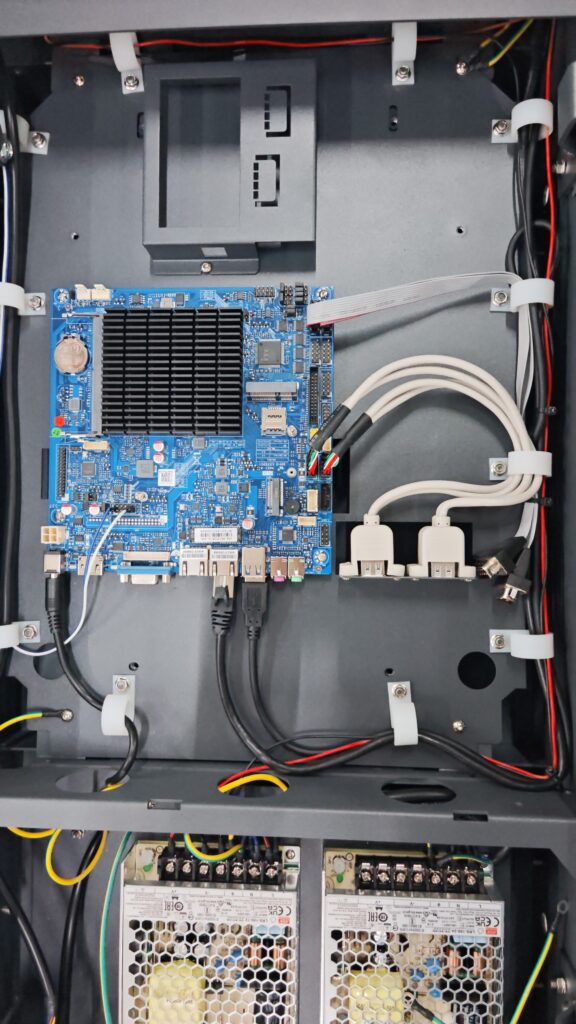
A reliable kiosk needs a clean internal layout. It also needs secure cable management and easy access for maintenance.
These details help technicians install, check, repair, and upgrade the machine faster.
At SOMANPOS, we build our self-service kiosks with real deployment in mind. We arrange key components clearly inside the machine. This helps technicians check the printer, scanner, motherboard, power supply, cables, and other modules more easily.
Clean Cable Management Inside the Kiosk
Clean cable management does more than make the machine look neat inside.
It helps reduce loose connections. It also improves safety and makes future service easier.
When cables follow a clear layout, technicians can find each module faster. This matters for kiosk projects with printers, scanners, NFC readers, cameras, speakers, payment brackets, and other devices.
In restaurants, retail stores, shopping malls, and public service areas, downtime can affect daily operation.
That is why a service-friendly internal structure matters.
Kiosk Internal Build for Software Integration
Software companies need hardware that can support their systems smoothly.
A self-service kiosk may need to work with POS software, ordering systems, payment systems, membership systems, or queue management systems.
Stable hardware makes software integration easier. It also helps reduce unexpected problems after deployment.
Before shipment, our team checks the assembly, cable connections, functions, and system performance. We also run aging tests to make sure the kiosk can support real business use.
Easy Maintenance Starts from the Inside
Installation is only the first step of a kiosk project.
After deployment, customers may need to replace printer paper, check cables, upgrade modules, or maintain internal parts.
If the inside of the kiosk is messy, technicians may need more time to solve even a small problem.
That is why SOMANPOS pays attention to both the outside design and the internal build quality.
We want our kiosks to look professional from the outside. More importantly, we want them to be easy to service from the inside.
Reliable Kiosk Testing Before Deployment
SOMANPOS self-service kiosks can support many business scenarios.
They can work in restaurants, retail stores, convenience stores, supermarkets, shopping malls, self-ordering projects, self-payment terminals, and service counters.
Different projects may need different hardware modules. These may include touch screens, thermal printers, barcode scanners, NFC readers, card readers, cameras, payment terminal brackets, and customized floor stands.
With OEM and ODM experience, SOMANPOS can provide flexible kiosk hardware solutions for different project needs.
Conclusion: Better Internal Build, Better Deployment
For software companies, POS solution providers, and system integrators, choosing a kiosk hardware manufacturer is not only about price or appearance.
The internal build quality of the kiosk also matters.
Clean cable management, stable system architecture, proper testing, and easy maintenance can make project deployment smoother.
At SOMANPOS, we focus on both what customers see outside and what technicians need inside.
Reliable kiosk hardware should help software integration, simplify maintenance, and support long-term operation in real business environments.
Contact SOMANPOS to explore customized self-service kiosk hardware solutions for your next restaurant, retail, or service project.


